World War I
The Master Butchers Singing ClubWorld War I is the decisive rupture behind the novel’s linked stories of survival, migration, and family life. Fidelis Waldvogel returns from the fighting carrying memories he cannot readily share; Cyprian Lazarre comes home bearing his own injuries and losses. Their silence does not mean the war has passed. It follows them into the friendships, work, and choices that shape life in America, while later generations inherit its political and personal consequences.
Return and the struggle to survive
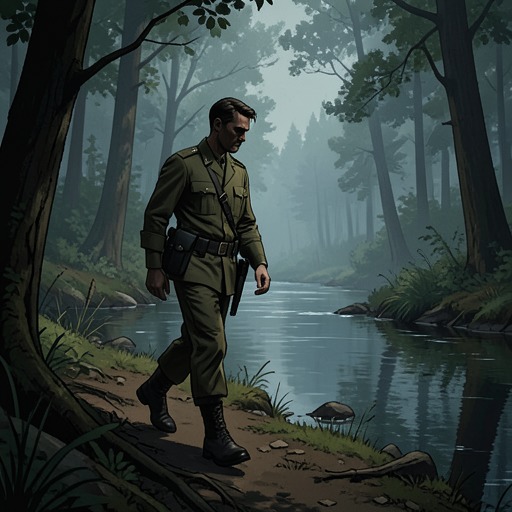
Fidelis walks home from the war in twelve days and sleeps for thirty-eight hours in his childhood bed. When he wakes in Germany in late November 1918, the redrawn border has left him only a few centimeters from becoming French. The altered map matters less to him than the prospect of food. His mother’s carefully aired and restuffed eiderdown, still marked by a childhood nosebleed, is a small remnant of home against the deprivation awaiting him. The passage makes demobilization no simple return to safety: even a familiar bed leads back to the urgent question of how to live.
In the years after the armistice, scarcity pushes Fidelis into dangerous economic choices, including entering the black market. His later journey to America grows out of the same pressure. In 1922 he steps from the RMS Mauretania into New York City carrying a suitcase of his father’s smoked sausage. The family has spent its remaining valuables and best clothing to pay for his passage and has kept him from selling his knives; his concealed rifle and carefully saved ammunition had helped him poach the boar used for the sausages. A skill inherited from home, and a commodity made from hard-won resources, become the means by which he can continue west.
Fidelis has little English, but he knows the words necessary to ask for a train. When he has not earned enough for the fare he needs, he chooses a more uncertain route: he buys a ticket into the beginning of the Middle West, boards with the sausages he has left, and sells them to fellow passengers. The move from ocean arrival to train travel turns migration into a practical sequence of improvisations. His passage is financed not by abundance but by the family’s last possessions, his labor, and his ability to make food valuable to strangers.
Combat and the lives it leaves behind
The novel places the two veterans’ experiences beside one another without making them identical. Cyprian had enlisted in the U.S. Marine Corps with a cousin and a friend. He survived training and the threat of Spanish flu, fought in the fourth wave at Belleau Wood, and returned with the effects of fire, chlorine gas, a machine-gun accident, and dysentery. During his recovery he could not vote, despite having served, because as an Ojibwe he was not yet a U.S. citizen. The war’s aftermath thus includes both bodily recovery and a civic exclusion that service had not erased.
Fidelis’s wartime role was that of a German sniper. A later reflection imagines the possibility that Cyprian had once been among the men in his sights, making their eventual friendship carry an unspoken proximity to the violence each had survived. The novel does not resolve that imagined encounter into certainty. Instead, the question sharpens the distance between battlefield roles and the men’s later lives: two former enemies can sit together without knowing exactly how their paths crossed in combat.
Their shared war is rarely discussed. It remains between them like ground once ruined and later covered with grass; memories arrive unpredictably, and each man pauses before carrying on. At the kitchen table, they acknowledge only what can be seen: the scars on Cyprian’s neck and the mark on Fidelis’s chin. They do not turn their experiences into the familiar, polished stories of veteran gatherings. Both have known the war’s horror, but neither finds glory in it or a story that can comfortably contain it. Their restraint is not an absence of memory; it is the form their memory takes in one another’s company.
Work, migration, and family after the armistice
Fidelis finds work with Pete Kozka, the local butcher, and also travels to nearby towns and farms to butcher animals when called. He initially has no car, but later owns a succession of delivery trucks. His work builds on the sausage-making knowledge his father gave him just before his departure. The principle is exacting: no ingredient is too humble, and the quality of salt, fresh garlic, meat, and casings all matters. In the novel, craft offers a durable practice after wartime destruction, while the growth of the trade shows how an immigrant’s specialized labor can become a livelihood and a foothold in a new place.
Economic pressures continue to shape the household. Delphine develops a sharp sense of what customers can buy and when a price must come down. A weekly grocery drawing brings people into the shop, while careful dealings with both wealthy customers and impoverished neighbors help keep its trade moving. She stocks dried beans and peas, bargains with farms, and expands the range of goods through a wholesaler. These details place the family’s business inside wider hardship: the war is over, but security still depends on labor, trade, and the careful management of limited means.
Later, Tante persuades Fidelis to let her take the boys to Germany, apart from Franz, who is nearly finished with school. She plans to raise them with their grandmother, who is lonely, and expects the separation to last no more than a year or two, until Fidelis can bring them back. She believes the store will prosper without the daily demands of the children and that the boys will return old enough to help. The proposed journey reverses the direction of Fidelis’s own migration: the family that he brought toward a new life considers sending its children back across the Atlantic, with work and kinship both weighing in the decision.
The decision is contested by the memory of political violence in Germany. Delphine has followed reports of the purge of 1934 and does not share the family’s attention to German prosperity, expanding holdings, and national strength. She fears that the boys’ trip could become a permanent separation as the danger in Europe grows. The novel therefore sets family longing for a homeland against the evidence of a changing political reality, making return neither a simple restoration nor a neutral family arrangement.
War’s memory, inheritance, and public remembrance
The veterans’ private silence is set against other ways of remembering the conflict. At the 1954 unveiling of a monument to the victims of the bombing of Ludwigsruhe, surviving master butchers gather from nearby villages and more distant towns to sing. Fidelis has practiced with the few men left alive. The ceremony gives their voices a public place, but the scene does not turn remembrance into uncomplicated celebration: the dead of the war are now part of the earth, and the ceremony takes place in a town transformed by destruction and rebuilding.
Delphine watches the singers and, as their voices merge into a single sound, thinks of her mother’s indistinct photograph and of the town’s history of burning and marching. The public gathering thus opens onto private and inherited histories rather than closing them. Singing can unite the surviving men in a shared act, yet the same scene evokes those absent from it and the violence the ceremony cannot undo. The contrast echoes the veterans’ earlier restraint: collective sound makes remembrance visible, while the full burden of experience remains difficult to articulate.
The novel also widens its account of wartime history beyond the European front. Its closing note connects the fictional story to the author’s family history: her grandfather fought in the German trenches in World War I, while his sons served on the American side in World War II. It also recalls an oral history of the massacre at Wounded Knee that says two people from the north, Cree or Ojibwe, died with Bigfoot’s people. These distinct histories are not made interchangeable; their juxtaposition underscores how war and state violence reach across generations and communities, and how remembrance depends on which stories are preserved and who is named.
World War I therefore functions both as a historical event and as a continuing condition of life in the novel. It sends Fidelis back into hunger and then across the Atlantic, places Cyprian’s military service beside his lack of citizenship, and leaves two veterans joined by what they cannot easily tell. Its aftereffects surface in family economies, decisions about where children belong, and ceremonies for the dead. The war ends on the calendar, but its consequences persist in work, movement, silence, and song.